The group left Fès at dawn on the twentieth day. Behind them, the city of scholars still slept, its minarets cutting through the morning mist like fingers reaching toward the sky. Before them, the road climbed toward the Middle Atlas, toward the cedars and ancient stones, toward what Lalla Zineb called axxam n igenwan — the house of the sky.
Youssef rode in silence, the manuscript pressed against his chest. Since the night of the betrayal, since Ibn Rachid's revelation, he had carried the parchment differently — no longer as an inherited burden, but as a promise to be honored. His father Baaddi had crossed the sea, had survived exile, had preserved these pages so they might find their homeland. That homeland, Youssef was beginning to understand, was not a library or a palace. It was a mountain.
Lalla Zineb walked on foot, refusing the mule offered to her. Her braided leather sandals trod the red earth with a familiarity that surprised the travelers. She knew every stone, every hidden spring, every tree twisted by winter winds. Fatima Tafraout watched her with an emotion she could not name — something between recognition and memory.
— You have walked this road before, said Fatima in Tamazight.
— I have walked this road since always, replied the old woman without turning. This is the road of our people. Before the Arabs, before the Romans, before all who came with their names for our mountains — we were here. And we will be here when they are gone.
Hamza, who understood Tamazight, translated for Youssef and Tarek. The soldier nodded with respect. Youssef closed his eyes for a moment, feeling in those words something that resonated with the pages of his father's manuscript — that same certainty that certain things survive everything.
At noon, they stopped near a spring that Lalla Zineb called tala n tmazirt — the spring of the homeland. The water was cold and clear, descending from the eternal snows of the peaks. They ate barley bread and dried figs, and the old woman produced from her bundle a vial of argan oil that she shared without a word.
It was there that Youssef dared to ask the question that had haunted him since the day before:
— Lalla Zineb, how did you know we would pass this way?
The old woman raised her eyes toward him. Her dark pupils held something ancient, as if they had witnessed centuries passing.
— I did not know it was you, she said. I knew a bearer would come. The signs had been there since the moon of Sha'ban. An eagle flying north. A star burning brighter than the others. And the dream — three times the same dream, a young man with a book and an old wound in his eyes.
Tarek coughed to hide his unease. Hamza looked at his hands. Fatima smiled softly, as if she had always known.
In the afternoon, the road crossed a forest of cork oaks whose trunks bore the scars of past harvests. Then the cedars appeared — first timidly, a few isolated trees on the ridges, then en masse, a dark green army smelling of resin and rain.
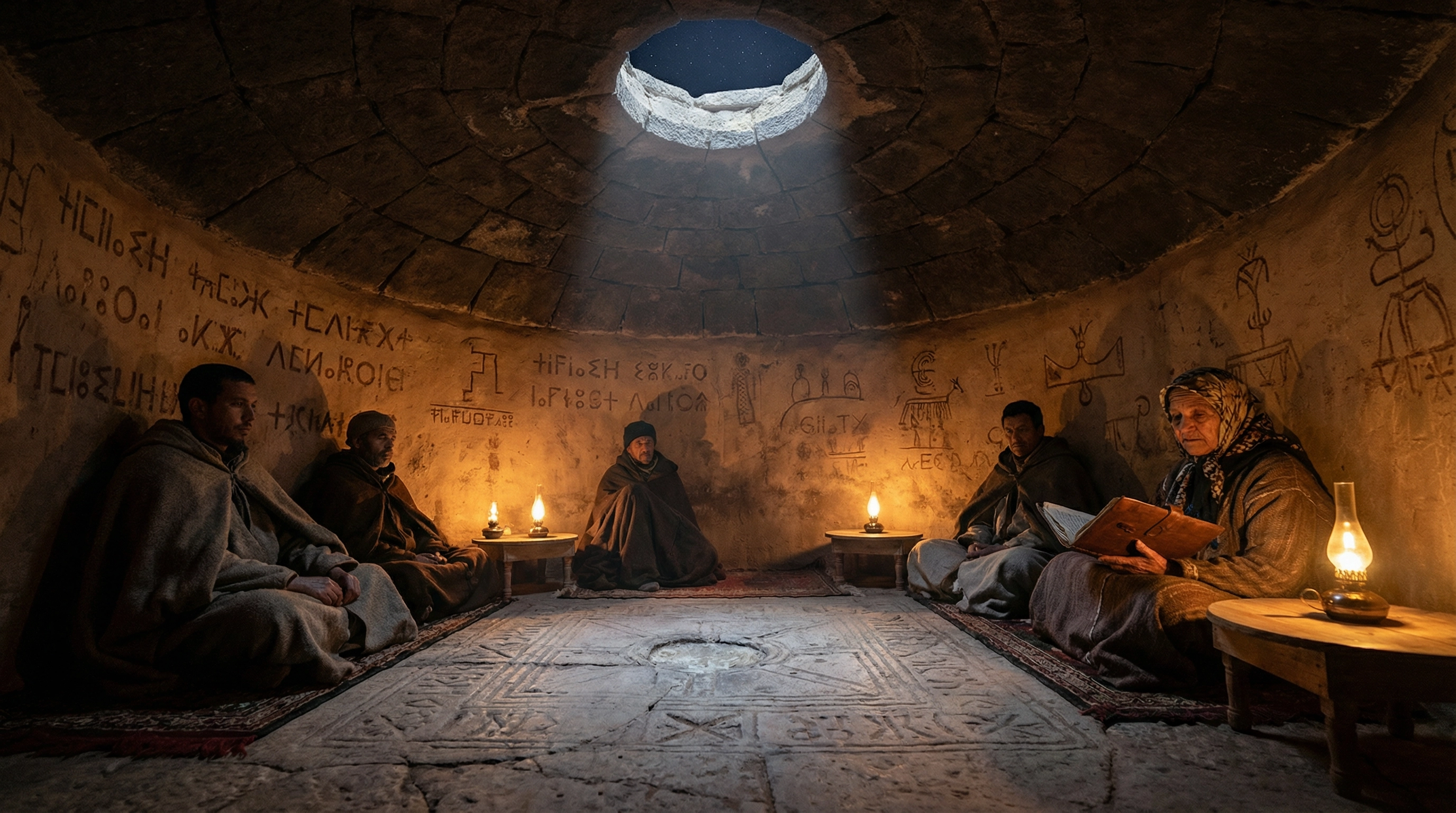
Lalla Zineb stopped before the first great cedar they encountered. She placed both palms on the rough bark and closed her eyes. Her lips moved in silence. Youssef saw, carved into the bark at human height, signs he did not recognize — neither Arabic, nor Latin, nor Greek.
— Tifinagh, Fatima whispered in his ear. The writing of our ancestors.
— What does it say?
Fatima narrowed her eyes to decipher it. — Here begins the territory of the dead who watch over the living.
They camped that evening in a clearing that Lalla Zineb chose with care — a natural circle of ancient cedars, like a hall without a roof. The fire they lit seemed brighter than elsewhere, its flames rising straight in the still air.
After the meal, the old woman asked to see the manuscript. Youssef hesitated — since Granada, he had let no one touch it. But something in Lalla Zineb's gaze told him this moment had been awaited for a long time.
She took the parchment with precise gestures, unfolded it on her knees and examined it by firelight. Her fingers covered with henna tattoos grazed the lines of text without quite touching them, as if she were reading with her skin.
— Your father was a wise man, she said at last.
— Did you know him?
— No. But I know what he wrote. These melodies — she tapped the parchment gently — they do not come from Andalusia. They come from here. From these mountains. Your father heard them somewhere, transcribed them in his language, gave them a new form. But the root is here, beneath our feet.
The silence that followed was inhabited. Somewhere in the forest, an owl called three times. Lalla Zineb smiled as if it were an expected answer.
— Tomorrow, she said, returning the manuscript to Youssef, we will arrive in Azrou. And there, you will understand why you came.
The night enveloped the clearing like a benevolent hand. The cedars kept watch. And for the first time since Granada, Youssef ibn Baaddi slept without dreaming of the sea.
Share this night
Your friends will see the night illustration and a short teaser — then come here to read the full story.